May CanaNight
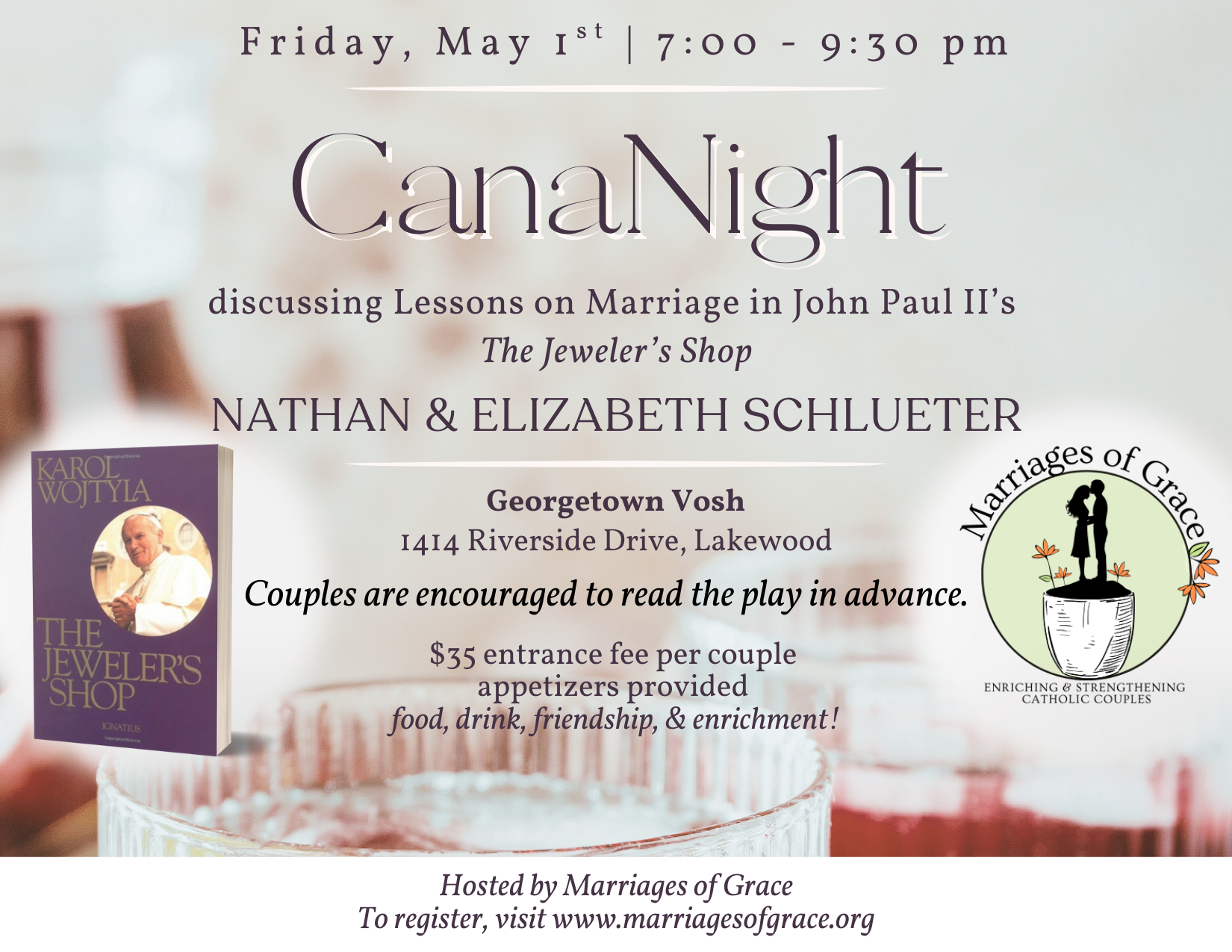
Join us for our May CanaNight with Dr. Nathan and Elizabeth Schlueter as they discuss John Paul II’s play, The Jeweler’s Shop
Of course you love your spouse. But are you friends with your spouse? Friendship grows through shared experiences, activities, challenges, and conversations. It can also grow by reading great literature together. Literature gives us experience, but in an imaginative space that is free from the stresses and strains of our personal lives. In the contemplative that almost magical space, we often find the grace of insight, healing, even transformation. This is perhaps one reason John Paul II was so fond of literature. Most people are aware of John Paul II’s theological and philosophical interests. But many people do not know that as a young man Karol Wojytla’s first love was drama – not only acting, but directing, playwriting, even translating classic poetry and works of drama into Polish. In 1941 he and four friends founded the underground Rhapsodic Theater, which sought to keep Polish culture alive during the Nazi and then Soviet occupations. In 1960 Wojtyla published two monumental works, Love and Responsibility and The Jeweler’s Shop. Both works explore human love, the first in the language of philosophy, the latter in the language of poetry. Love and Responsibility is rightly celebrated, but The Jeweler’s Shop is every bit its poetic equal, and even necessary complement to the philosophical work. In this event we will explore lessons on marriage in The Jeweler’s Shop. We strongly encourage you to read this play together in advance. (The movie is no substitute!). We know how difficult is for married couples, especially those caring for children, to find the mental and emotional energy to read. But this work is short, and you will not regret powering through.
Here are some tips to help you out.
1) Pace yourself. Read just a little at a time, even just a few pages each night. If you want to, mark arresting words, images or ideas with a pencil.
2) Think of it as a poem, not a play. (The subtitle calls it a “meditation,” and you should treat it that way.)
3) Don’t be discouraged by the strangeness. The non-linear structure, surprising imagery, “magical” characters, etc., are part of the charm! You will be able to follow the story.
4) What is the story about? Most simply:
a. Act One: A Good Marriage [Teresa and Andrew]
b. Act Two: A Bad Marriage [Anna and Stefan]
c. Act Three: The Marriage of two Children from the Good and Bad Marriages [Monica and Christopher]
5) Here are a few questions to think about:
a. What insights and questions did you have while you were reading? Did the poem lead to any good discussions?
b. What is the meaning of each title?
c. What is the plot?
d. Who are the characters? What are their particular struggles? What kind of judgments about them did you find yourself making as you read?
e. Did you notice any Biblical allusions. What do they mean?
f. How does the poem end? Is it hopeful?
Elizabeth and Nathan Schlueter
Nathan and Elizabeth have been married 26 years. They have nine children, and one grandchild.
Elizabeth has a B.A. in Politics and M.T.S. from the University of Dallas. In addition to being a homemaker, she is the Assistant Academic Director of Canavox, an international marriage organization. She has experience teaching as an R.C.I.A. director, a homeschooler, and a teacher at a classical hybrid school.
Nathan is a philosophy professor at Hillsdale College, where he teaches a popular course on the Philosophy of Love, Sex, and Marriage. He is the author of multiple books and articles, as well as the popular online course “Introduction to Western Philosophy.” He is a recipient of Hillsdale College’s Award for Teaching Excellence and the teacher of the popular online Hillsdale course “Introduction to Western Philosophy.” He also serves on the Bishop’s Commission on Catholic Social Teaching.